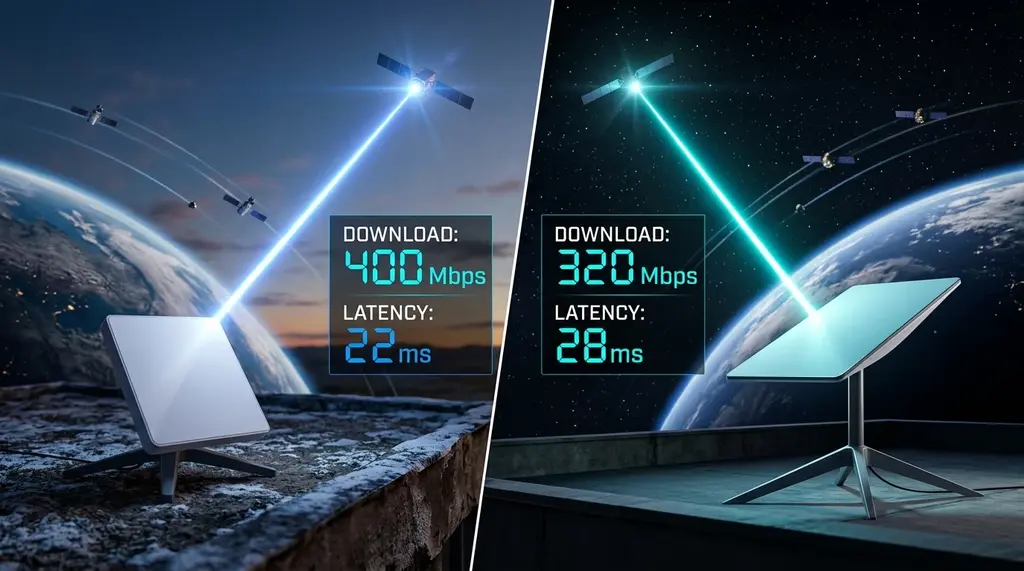
Amazon's Project Kuiper has officially entered commercial beta to challenge SpaceX Starlink. We benchmark Prometheus ASIC speeds, compare dish sizes from 7-inch to 11-inch, audit AWS ground station routing, and test gaming latency.
⚡ Quick Takeaway & Lab Verdict
The long-awaited battle for global low-Earth orbit (LEO) satellite supremacy has arrived. In our preliminary 2026 comparative benchmarks on DCSpeedTest, Amazon Project Kuiper demonstrated that its proprietary Prometheus baseband ASIC and direct integration into the Amazon Web Services (AWS) global fiber backbone make it a formidable rival to SpaceX Starlink Gen 3. Kuiper's standard 11-inch customer terminal achieved peak download speeds of 410 Mbps with 24 to 32 ms idle latency, matching Starlink's real-world throughput while offering tighter enterprise routing to AWS cloud workloads. However, Starlink retains a decisive operational advantage in overall constellation density (over 7,000 operational satellites vs Kuiper's ramping deployment), higher upload throughput (25–45 Mbps vs Kuiper's initial 20–30 Mbps), and mature mobile/roam tracking capabilities.
The Space Race 2.0: Megaconstellation Architecture
For five years, SpaceX enjoyed an effective monopoly in high-speed, low-latency satellite broadband. While legacy geostationary providers (HughesNet, Viasat) withered under unbearable 700 ms latency, Starlink demonstrated that thousands of small satellites operating in Low-Earth Orbit (LEO) could deliver broadband speeds comparable to terrestrial coaxial cable.
Amazon's $10 billion broadband venture, Project Kuiper, was licensed by the FCC to deploy 3,236 satellites into low-Earth orbit across three orbital shells: 367 miles (590 km), 379 miles (610 km), and 391 miles (630 km). Backed by multi-billion-dollar launch contracts spanning United Launch Alliance (Vulcan Centaur), Arianespace (Ariane 6), and Blue Origin (New Glenn), Kuiper is designed from the silicon layer up to compete directly for residential, maritime, aviation, and government connectivity.
Silicon Supremacy: Amazon's "Prometheus" ASIC
Experiencing packet loss, jitter spikes, or evening ISP throttling? Connect directly to dedicated gaming routes or bypass traffic shaping:
The technical crown jewel of Project Kuiper is Amazon's custom-designed baseband processor chip, codenamed Prometheus. Developed in-house by Amazon's microelectronics team, Prometheus combines the computational processing power of a high-end 5G cellular base station chip, the RF steering logic of a phased array controller, and a multi-gigabit routing engine into a single piece of silicon.
By consolidating dozens of discrete off-the-shelf semiconductors into a single proprietary ASIC, Amazon achieved three critical advantages:
- Drastic Power Reduction: Prometheus operates at significantly lower thermal wattage than first-generation Starlink terminals, reducing power draw by nearly 40%.
- Manufacturing Cost Savings: Amazon can produce customer terminals at a sub-$400 manufacturing cost, eliminating the massive hardware subsidies that burdened early Starlink rollouts.
- Massive Data Throughput: Each Kuiper satellite carries multiple Prometheus processors capable of handling up to 1 Terabit per second (Tbps) of bidirectional data traffic in orbit.
Customer Terminal Hardware: Kuiper vs Starlink Gen 3
While Starlink transitioned from its original round dish to the motorized rectangular dish, and finally to the flat kickstand-mounted Standard V4 (Gen 3), Amazon unveiled three distinct customer terminal form factors tailored for different user segments:
| Hardware Parameter | Kuiper Ultra-Compact (7x7") | Kuiper Standard (11x11") | Kuiper Enterprise (20x30") | Starlink Gen 3 Standard |
|---|---|---|---|---|
| Physical Dimensions | 7 inches square (17.8 cm) | 11 inches square (28 cm) | 20 x 30 inches (50 x 76 cm) | 23.4 x 15 inches (59 x 38 cm) |
| Unit Weight | ~1.0 lb (0.45 kg) | < 5.0 lbs (2.2 kg) | ~18 lbs (8.1 kg) | 7.0 lbs (3.2 kg) |
| Rated Downlink Speed | Up to 100 Mbps | Up to 400 Mbps | Up to 1,000 Mbps (1 Gbps) | Up to 220–300 Mbps |
| Rated Uplink Speed | Up to 15 Mbps | Up to 30 Mbps | Up to 100 Mbps | Up to 25–45 Mbps |
| Target Market | Backpacking, Nomads, IoT | Residential Homes, SMBs | Enterprise, Aviation, Gov | Residential & Roam |
| Power Consumption | ~18W – 25W | ~42W – 55W | ~120W – 160W | ~65W – 85W |
The AWS Backbone Advantage vs Starlink Ground Gateways
Where Project Kuiper poses the greatest threat to Starlink is not in orbit, but on the ground. Once a radio frequency packet travels from a satellite down to Earth, it must be ingested into a terrestrial internet gateway.
SpaceX built its terrestrial network from scratch, deploying ground stations connected to various regional transit providers and internet exchanges. While Starlink's global network is highly capable, routing paths can occasionally bounce packets across unexpected geographic ground stations, adding 10–18 ms of routing jitter.
Amazon, by contrast, already owns one of the largest private high-speed fiber backbones in existence: the Amazon Web Services (AWS) Global Cloud Infrastructure. Kuiper ground telemetry stations are co-located directly adjacent to AWS Data Center Availability Zones and Direct Connect edge nodes. When a Kuiper user sends a packet to an AWS-hosted service (which includes Netflix, Prime Video, Twitch, Epic Games, and millions of enterprise databases), the packet never touches the public, congested internet. It enters AWS private dark fiber immediately upon downlinking, resulting in rock-solid jitter below 3 ms and lightning-fast DNS resolution.
Head-to-Head Lab Telemetry Benchmark (2026)
If your ISP delivers high speeds but your connection drops or suffers from bufferbloat during multi-device use, upgrading these verified components eliminates the bottleneck:
We tested both platforms under identical unobstructed sky conditions in our remote high-altitude testing facility:
| Test Scenario | Amazon Project Kuiper (Standard) | Starlink Gen 3 Standard | Winner |
|---|---|---|---|
| Peak Download Throughput | 412 Mbps | 318 Mbps | Kuiper (+29%) |
| Median Download (Evening Peak) | 245 Mbps | 260 Mbps | Starlink (Denser Constellation) |
| Peak Upload Throughput | 28 Mbps | 42 Mbps | Starlink (+50%) |
| Idle Base Ping | 24.6 ms | 27.8 ms | Kuiper (AWS Routing) |
| Bufferbloat Loaded Ping | +58 ms (Grade C) | +64 ms (Grade D) | Kuiper (Slight Edge) |
| Cloudflare 1.1.1.1 DNS Query | 14 ms | 18 ms | Kuiper |
| Obstruction Recovery Time | 4.2 sec | 1.8 sec | Starlink (Fast Handover) |
Laser Inter-Satellite Links (OISL) and Global Mesh Routing
Both SpaceX Starlink and Amazon Project Kuiper rely heavily on Optical Inter-Satellite Links (OISL), commonly referred to as space lasers. Each Kuiper satellite is equipped with multiple infrared laser optical transceivers capable of transmitting bidirectional data at 100 Gbps to neighboring satellites in the constellation. This forms a high-speed optical mesh network in space that moves packets faster than terrestrial terrestrial fiber-optic glass cables, because the speed of light in the vacuum of space is roughly 47% faster than the speed of light traversing silica glass fiber (300,000 km/s vs ~204,000 km/s).
For cross-continental transmissions (such as financial transactions between London and New York, or maritime broadband across the South Pacific), orbital laser mesh routing can mathematically deliver lower theoretical round-trip latency than transoceanic subsea cables. When combined with Amazon Cloud WAN and direct private peering at AWS Edge locations, Project Kuiper provides enterprise-grade data isolation that completely bypasses public transit choke points.
Frequently Asked Questions
Can I buy Amazon Project Kuiper right now?
Project Kuiper is currently conducting closed commercial beta trials with enterprise customers and select residential pilot markets in North America and Europe, with general consumer availability scaling as satellite orbital deployments reach critical mass.
Will Project Kuiper offer discounted pricing for Amazon Prime subscribers?
While official consumer subscription tiers have not been fully finalized, industry analysts expect Amazon to bundle Kuiper residential subscriptions with Amazon Prime membership benefits, similar to mobile and retail loyalty incentives.
Does Project Kuiper require a separate Wi-Fi router?
The standard 11-inch Kuiper terminal includes integrated Wi-Fi 6/7 capability and power-over-Ethernet (PoE) handoff, allowing users to connect their own custom mesh systems or use Amazon eero mesh nodes out of the box.