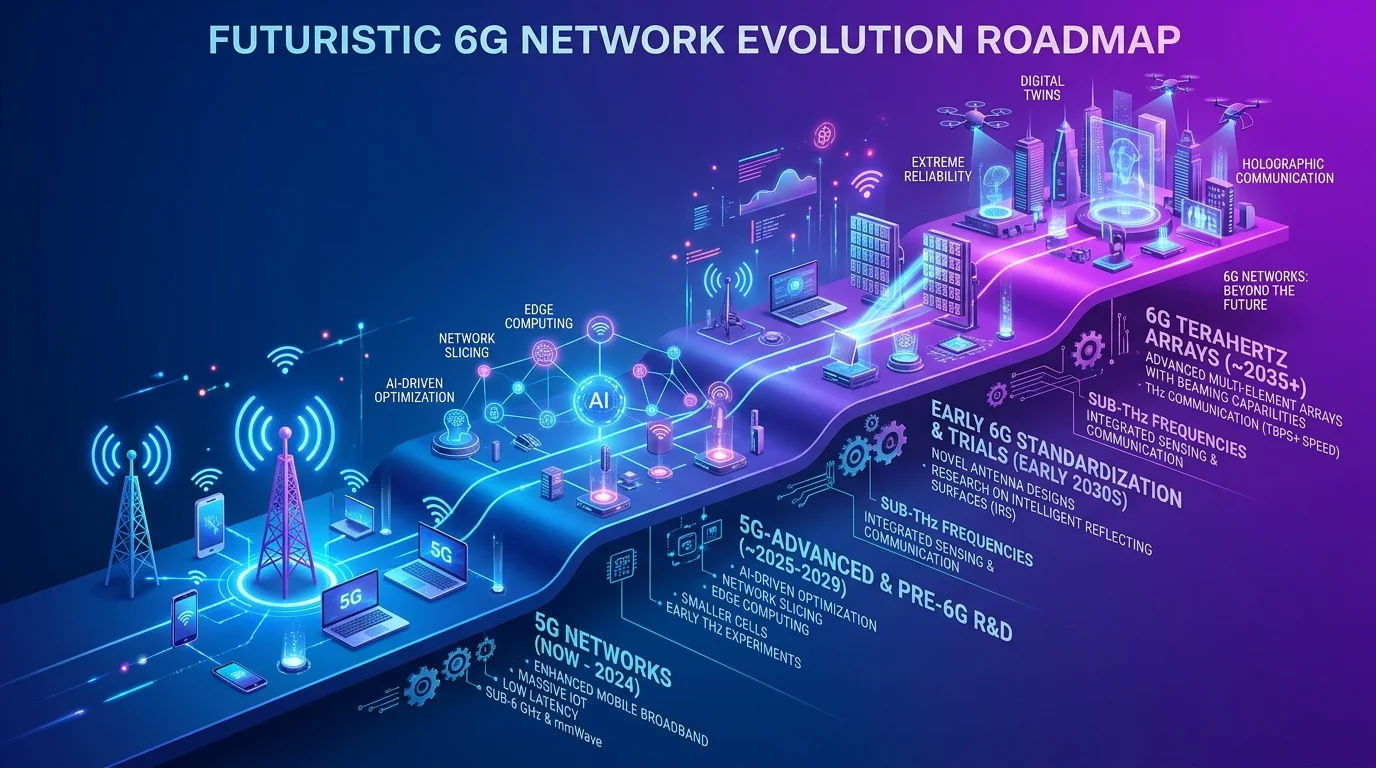
The Terabit Era
5G was about connecting things. 6G is about connecting intelligence. We're talking about speeds that make downloading a holographic movie instantaneous.
Integrated Sensing and Communication (ISAC)
6G networks won't just carry data; they will act as high-resolution radar systems. Your 6G signal could detect gestures, track health metrics, and map environments in real-time without needing cameras.
The Realistic Timeline
Despite the headlines, 6G won't replace your home WiFi — or your 5G Home Internet — anytime soon. The ITU's official roadmap targets standardization around 2028-2029, with the first commercial pilot deployments expected in dense urban test markets by 2030. Carriers are currently running lab trials at terabit speeds over distances measured in meters, not miles — the leap to citywide coverage is a different engineering problem entirely.
What Actually Changes for You First
Before any 6G phone reaches your pocket, expect 5G-Advanced (3GPP Release 18-20) to roll out through 2027, quietly delivering most of the latency and reliability gains 6G promises — without requiring new towers or new phones. If your current connection already feels fast and stable, 6G is a "someday" upgrade, not a "should I wait" one.
Frequently Asked Questions
When will 6G actually be available to consumers?
Realistically, not before 2030 for limited markets, with broad availability likely into the early-to-mid 2030s. Standardization itself isn't expected to complete until around 2028-2029 — every "6G launch" headline before then refers to lab trials or prototype demonstrations, not commercial service.
Should I avoid buying a 5G phone because 6G is coming?
No. 5G networks will remain the global standard for at least another decade, and 6G devices will be backward-compatible with them. A 5G phone bought today will keep working normally long after 6G launches in your area.