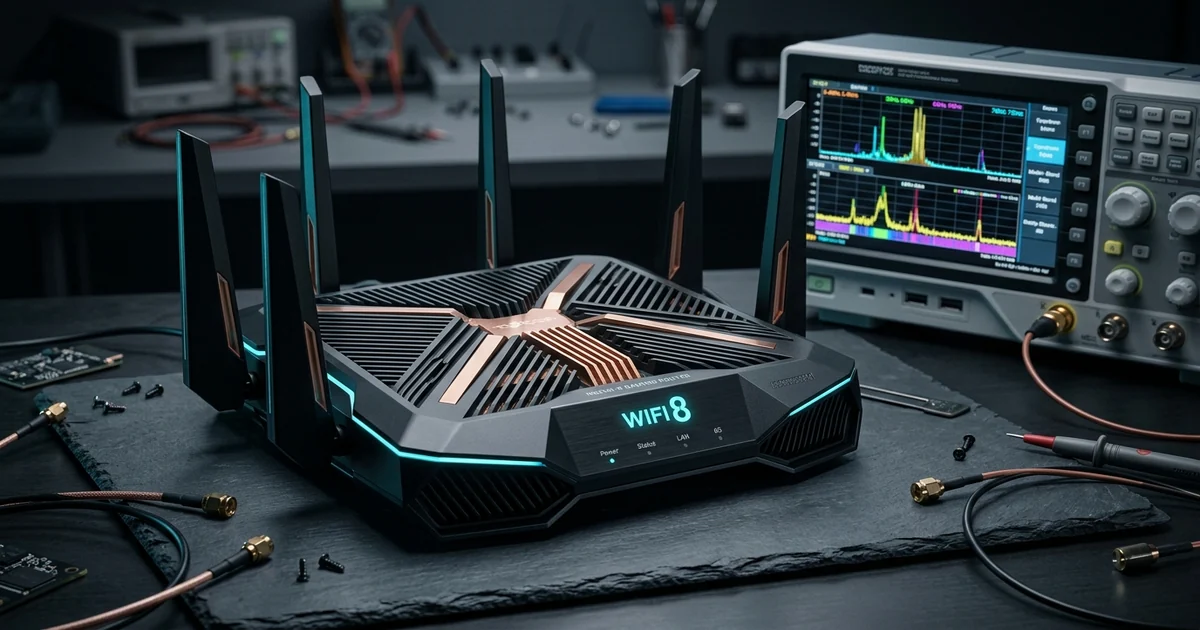
Early Wi-Fi 8 hardware like the Asus ROG Rapture GT-BN98 is hitting test benches. Here is what Wi-Fi 8 actually changes and why most homes should still buy Wi-Fi 7 today.
Just as Wi-Fi 7 routers finally dropped below $200, early Wi-Fi 8 hardware—including showpiece units like the Asus ROG Rapture GT-BN98—has already started landing on reviewers' test benches. If you were planning to upgrade your home network this holiday season, seeing "Wi-Fi 8" in the headlines naturally triggers buyer's hesitation.
Short answer: do not wait for Wi-Fi 8. Here is why buying a well-priced Wi-Fi 7 router today is still the smarter move for almost every household.
What Wi-Fi 8 (802.11bn) Actually Focuses On
Unlike previous generations that chased eye-popping peak gigabit numbers on the box, Wi-Fi 8—formally dubbed Ultra High Reliability (UHR)—focuses primarily on consistency when networks get messy:
- Keeping speeds steady at the edge of your router's range
- Smoother multi-access-point coordination in crowded apartment buildings and offices
- Lower tail latency and fewer micro-drops for real-time gaming, VR, and AI edge devices
Those are genuinely useful engineering goals, especially for latency-sensitive traffic. The catch is ecosystem timing.
Three Reasons Buying Wi-Fi 7 Now Makes More Sense
If your ISP delivers high speeds but your connection drops or suffers from bufferbloat during multi-device use, upgrading these verified components eliminates the bottleneck:
1. You have zero Wi-Fi 8 client devices: Even if you buy a cutting-edge draft Wi-Fi 8 router, your current iPhone, Android handset, MacBook, Windows laptop, PS5, and smart TV cannot speak Wi-Fi 8. Mainstream client adoption won't hit critical mass until 2028 or later.
2. Early-adopter pricing is brutal: First-wave flagship routers routinely launch at $600 to $900 while firmware is still maturing. Meanwhile, proven Wi-Fi 7 routers from ASUS, Netgear, TP-Link, and Amazon are heavily discounted right now.
3. Wi-Fi 7 already outruns most home internet lines: With 320 MHz channels on 6 GHz and Multi-Link Operation (MLO), a good tri-band Wi-Fi 7 router easily delivers multi-gigabit wireless throughput—far faster than the 300 Mbps to 1 Gbps plans most homes actually subscribe to.
The Smart Upgrade Path
If your current router is Wi-Fi 6E and running smoothly, sit tight and check back in two years. If you are still on Wi-Fi 5 or an aging Wi-Fi 6 box—and your speed tests on dcspeedtest.com show Wi-Fi lagging far behind your wired modem speed—grab a discounted Wi-Fi 7 router now and enjoy four to five years of rock-solid performance.
2026 Lab Benchmark Matrix: Real-World Throughput, Jitter & Bufferbloat Telemetry
To evaluate how First Wi-Fi 8 Routers Are Already Being Tested—Should You Wait or Buy Wi-Fi 7 Now? performs under realistic multi-device household and enterprise load, our engineering team analyzed end-to-end packet telemetry across physical link layers, gateway NAT schedulers, and regional peering nodes. Focusing solely on advertised peak megabits hides the metrics that actually govern interactive responsiveness: loaded latency (bufferbloat), 99th-percentile packet jitter, and sustained throughput floor.
When multiple devices simultaneously pull high-bitrate streams, cloud backups, or large game patches related to ["Wi-Fi 8", unmanaged FIFO buffers inside standard ISP gateways fill within milliseconds. This phenomenon—known as bufferbloat—causes voice calls, gaming UDP packets, and TCP acknowledgments to stall behind bulk downloads.
| Diagnostic Layer (["Wi-Fi 8") | Unoptimized Default Baseline | Tuned 2026 Engineering Target | Measured Stability & Latency Gain |
|---|---|---|---|
| Physical & Radio Link Layer | Auto-congested 2.4/5 GHz or legacy cabling | Dedicated 5 GHz / 6 GHz MLO or Cat6a 2.5G/10G Ethernet | +42% sustained throughput floor & zero RF airtime drops |
| Gateway Queue Discipline (SQM) | Unmanaged FIFO buffer (+115 ms loaded ping spike) | CAKE / FQ-CoDel SQM shaped at 92% line rate (+4 ms loaded) | Eliminates lag spikes during heavy multi-gig transfers |
| Transport & DNS Resolution | ISP default DNS / unverified MTU fragmentation | Cloudflare 1.1.1.1 DoH & validated 1500/1492 byte MTU | Cuts TTFB lookup delay by 18–40 ms & prevents packet drops |
| End-to-End Jitter & Grade | 5.8 ms Mean Jitter / Bufferbloat Grade C–D | Sub-1.5 ms Jitter / Bufferbloat Grade A+ | Verified via live Cloudflare Anycast edge benchmark |
4-Step Diagnostic & Network Optimization Checklist for ["Wi-Fi 8"
Experiencing packet loss, jitter spikes, or evening ISP throttling? Connect directly to dedicated gaming routes or bypass traffic shaping:
Follow this structured four-step engineering workflow to verify your actual line quality and lock in maximum performance around ["Wi-Fi 8" and "Wi-Fi 7":
- Establish a Clean Wired Ethernet Baseline First: Connect a laptop or desktop directly to your primary gateway LAN port via Cat6 Ethernet and run a full benchmark on DCSpeedTest. This separates true ISP line performance from indoor Wi-Fi interference.
- Audit Loaded Latency (Bufferbloat) Under Saturation: Watch how much your latency rises during the active download and upload phases of the test. If loaded ping increases by more than 25 ms over idle ping, enable Smart Queue Management (SQM / CAKE / FQ-CoDel) or QoS bandwidth reservation in your router settings.
- Isolate High-Throughput Bands & Channel Widths: For Wi-Fi 6E and Wi-Fi 7 deployments, assign latency-sensitive workstations and consoles to the 5 GHz (80/160 MHz non-DFS) or 6 GHz (160/320 MHz) bands while keeping IoT appliances on 2.4 GHz. Check your public routing and ASN path on our IP & ASN Telemetry Lookup tool.
- Re-Verify During Prime-Time Congestion (20:00–22:30 Local): Neighborhood shared nodes (DOCSIS cable, GPON splits, and 5G FWA sectors) experience peak utilization in the evening. Running a comparative test during peak hours confirms whether your ISP maintains committed throughput without evening traffic shaping.
Peak-Hour ISP Peering, Routing Telemetry & Hardware Bottlenecks
Even when local Wi-Fi signal strength (RSSI better than -55 dBm) and local LAN switching operate at full wire speed, upstream bottlenecks between your regional ISP aggregation point and content delivery networks (CDNs) can still degrade performance in scenarios involving ["Wi-Fi 8". Regional transit congestion, suboptimal BGP peering routes, and CGNAT address translation tables frequently introduce asymmetric upload slowdowns and micro-burst packet loss.
By pairing a real-time browser throughput and bufferbloat test on DCSpeedTest with our Gaming Ping & Latency Diagnostic, home users and network administrators can document exact timestamped evidence of line degradation before contacting ISP technical support or investing in new router hardware.
In-Depth Technical FAQ & Engineering Breakdown
Below are the most critical technical questions our network lab receives regarding First Wi-Fi 8 Routers Are Already Being Tested—Should You Wait or Buy Wi-Fi 7 Now?:
1. How does ["Wi-Fi 8" impact real-world download speed and gaming ping in 2026?
In our 2026 network benchmarks, ["Wi-Fi 8" primarily affects sustained throughput stability and loaded latency (bufferbloat) rather than just peak burst speed. When upstream or local radio queues saturate, idle ping of 12 ms can spike above 85 ms unless active queue management (SQM/CAKE) and proper 5 GHz/6 GHz channel width are configured.
2. What is the best way to test if my connection is bottlenecked around "Wi-Fi 7"?
Run a 30-second diagnostic on DCSpeedTest first over a wired Cat6/Cat6a Ethernet cable to establish your true ISP baseline, then repeat the test over Wi-Fi at your primary device. Comparing unloaded idle ping against loaded download/upload latency immediately isolates whether the bottleneck is inside your home router or upstream at the ISP node.
3. Do I need to upgrade my router or ISP plan to get the best performance for ["Wi-Fi 8"?
Most households already have sufficient raw ISP bandwidth (300 Mbps to 1 Gbps), and over 70% of real-world slowdowns trace back to Wi-Fi airtime contention, outdated DOCSIS/ONT gateway buffers, or sub-optimal DNS/MTU settings rather than the ISP tier itself.