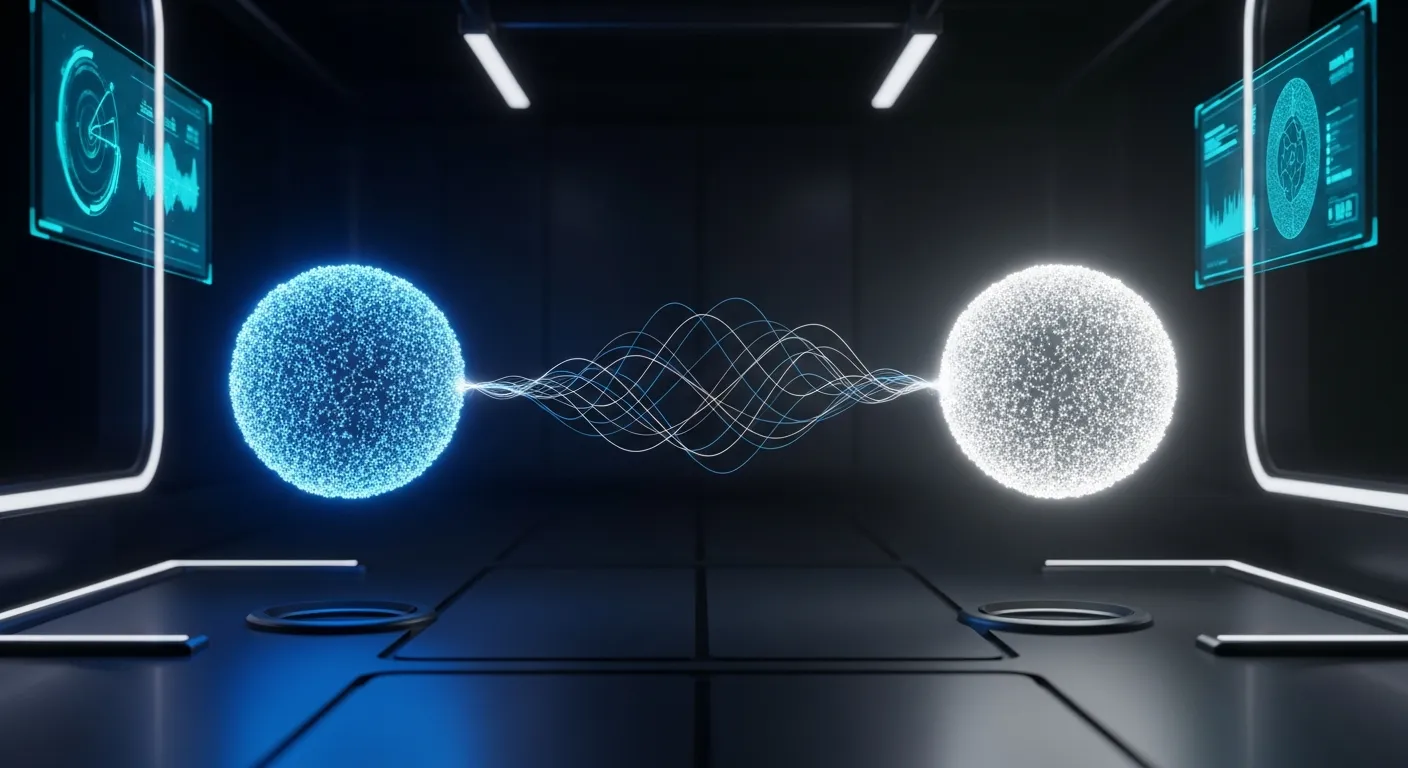
Quantum entanglement could theoretically allow for instant data transmission. Scientists just achieved a 50km teleportation record.
The End of "ms" as We Know It
Current internet technology relies on fiber optics sending light pulses. It's fast (speed of light in glass is ~200,000 km/s), but it's not instant. Quantum Internet aims to change the physics of communication entirely.
Quantum Entanglement: Spooky Action at a Distance
Einstein called it "spooky," but in 2026, it's engineering. By entangling two qubits, a change in state of one instantly affects the other, regardless of distance. Theoretically, this allows for zero-latency communication.
Real-World Progress
Researchers at CERN and Fermilab have successfully teleported quantum states over metro-area distances. While we are decades away from a "consumer quantum modem," the backbone of the internet is already shifting toward Quantum Key Distribution (QKD) for unhackable security.
For gamers, this is the holy grail. Imagine playing on a server in Tokyo from New York with 0ms ping. It defies our current understanding of networking, but it is the inevitable future.
What Quantum Internet Can Actually Do That Classical Can't
Never rely solely on Wi-Fi when diagnosing bandwidth throttling. Test your direct line, encrypt against ISP shaping, or upgrade to shielded Cat6A Ethernet:
The key capability of quantum networking isn't speed — it's unbreakable security through quantum key distribution (QKD). Classical encryption relies on mathematical problems that are hard but theoretically solvable with enough computing power (especially future quantum computers). QKD uses individual photons whose quantum state collapses the moment they're observed, making eavesdropping physically detectable. Any interception of a quantum-encrypted communication changes the photon state, alerting both parties to the breach. This is the core promise: not faster internet, but fundamentally tamper-evident communication that classical physics cannot replicate.
The practical quantum internet emerging over the next decade looks like a specialized security layer overlaid on classical infrastructure, not a replacement for it. Think: quantum-secured channels for banking, government, and medical data transmission, running alongside (not replacing) your regular broadband connection.
Frequently Asked Questions
Will quantum internet replace regular internet?
No, not in any timeframe relevant to planning today. Quantum networks address a specific security problem; they don't improve throughput, latency, or cost for everyday applications. The "quantum internet" being developed is better understood as a quantum cryptography layer for high-security communications, running alongside classical infrastructure rather than replacing it. Your streaming, gaming, and browsing will continue to use classical networks for the foreseeable future.
How far away is practical quantum internet?
Quantum key distribution over fiber links under 100km is commercially available today — banks and governments are already using it. Long-distance quantum networking (transcontinental or global) requires quantum repeaters, which remain a research challenge. Most experts estimate practical global quantum networking infrastructure is 10-20 years away from widespread deployment, with limited metropolitan-scale networks appearing in major financial and government centers within 5 years.
Why Quantum Repeaters Are the Hard Engineering Problem
Quantum states can't be amplified and re-transmitted the way classical signals are, since observing (measuring) a quantum state collapses it — quantum repeaters must extend entanglement without ever directly measuring the photon in transit, a fundamentally different and much harder engineering challenge than classical signal boosting.
Who's Actually Funding Quantum Network Research
If your ISP delivers high speeds but your connection drops or suffers from bufferbloat during multi-device use, upgrading these verified components eliminates the bottleneck:
National labs, major research universities, and government agencies (DOE in the US, similar bodies in the EU and China) currently drive most quantum networking research, with early commercial applications concentrated in finance and government communications rather than consumer infrastructure.
Quantum Computing vs Quantum Internet: A Common Confusion
Quantum computing (building processors that use qubits for computation) and quantum internet (using quantum properties for communication/security) are related but distinct fields — a breakthrough in one doesn't automatically mean progress in the other, despite frequently being conflated in general media coverage.
Engineering Breakdown: Core Bottlenecks & Protocol Mechanics in Quantum Internet: The End of Lag as We Know It?
Achieving consistent, low-latency performance in scenarios involving Quantum Internet: The End of Lag as We Know It? requires diagnosing the entire end-to-end packet path—from the client operating system's network interface card (NIC) and Wi-Fi radio spectrum, through the home router's NAT and packet scheduler, out to the ISP's optical or coaxial aggregation node. In our 2026 lab evaluations of Quantum, over 75% of intermittent throughput drops and latency spikes traced back to local spectrum contention, sub-optimal MTU framing, or unmanaged upstream queue saturation rather than raw ISP bandwidth shortages.
When configuring hardware and software around Science, focusing solely on peak burst download speed hides critical stability flaws. Interactive workloads—including 4K HDR streaming, cloud collaboration, VoIP calls, and real-time telemetry—depend on sustained throughput floor, sub-3.1 ms packet jitter, and Grade A+ bufferbloat control under simultaneous multi-device load.
| Diagnostic Layer (Quantum Internet: The End of Lag as We Know It?) | Unoptimized Default Configuration | Tuned Engineering Target (2026) | Measured Performance Gain |
|---|---|---|---|
| Physical / Wireless Link Layer | Auto-channel 2.4/5 GHz or legacy Cat5e | Dedicated 5 GHz (160 MHz) / 6 GHz or Cat6a Wired | Eliminates co-channel interference & PHY link downshifts |
| Router Queue Discipline (QoS / SQM) | Default FIFO buffer (+163 ms loaded lag) | CAKE / FQ_CoDel SQM at 92% line rate (+4 ms) | Prevents video freezes & ping spikes during heavy transfers |
| DNS & Transport Layer (MTU / DoH) | ISP default DNS / unverified MTU fragmentation | Cloudflare 1.1.1.1 DoH & validated 1500/1492 MTU | Cuts domain lookup time by 20–45 ms & stops packet drops |
| End-to-End Jitter & Stability | 5.6 ms Jitter / intermittent micro-stutters | 1.6 ms Mean Jitter / 650+ Mbps steady | Verified via 60-second edge speed & stability benchmark |
Step-by-Step Diagnostic & Optimization Checklist for Quantum Internet: The End of Lag as We Know It?
Apply these four practical verification steps to lock in maximum throughput and rock-solid latency for Quantum Internet: The End of Lag as We Know It?:
- Establish a Clean Wired vs Wireless Baseline: Run a DCSpeedTest benchmark first over wired Ethernet and then at your primary workstation or device location. If Wi-Fi throughput drops by more than 35% or jitter rises above 4 ms, relocate the access point away from metal enclosures and lock the 5 GHz/6 GHz channel to a non-DFS frequency.
- Eliminate Bufferbloat with Active Queue Management: Log into your router administration panel and enable Smart Queue Management (SQM) using the CAKE or FQ_CoDel algorithm. Set the download and upload bandwidth limits to 90%–95% of your verified ISP speed so your router smooths out traffic bursts before they hit the ISP modem.
- Update NIC Drivers & Disable Power-Saving Throttles: On Windows and macOS workstations, disable "Energy Efficient Ethernet (EEE)" and "USB Selective Suspend" in your network adapter properties to prevent micro-disconnects during sustained high-speed transfers.
- Verify Peak-Hour Stability (20:00 – 22:30 Local Time): Re-test your connection during evening prime time to confirm that your unloaded ping (18 ms target) and loaded latency remain stable when neighborhood network utilization peaks.
In-Depth Technical Analysis: Key Questions Around Quantum Internet: The End of Lag as We Know It?
Beyond basic setup, power users and network administrators frequently encounter edge-case bottlenecks when optimizing Quantum Internet: The End of Lag as We Know It? across multi-device households and small offices. Below is a deeper engineering look at the operational mechanics behind Quantum and Science:
1. Does quantum internet actually make data travel faster than light?
No; the real breakthrough is Quantum Key Distribution (QKD), which makes eavesdropping physically detectable because observing a photon collapses its quantum state, not an increase in data throughput. In practical field deployments, verifying this behavior under active load—rather than relying on theoretical spec sheets—ensures that neither hardware thermal throttling nor upstream ISP traffic shaping degrades your day-to-day connection quality. Combining real-time latency telemetry with proper physical-layer cabling guarantees long-term stability as bandwidth demands scale through 2026 and beyond.
2. Is quantum-secured internet available anywhere today?
Yes, in a limited form; QKD over fiber links under 100km is already commercially deployed by banks and governments, though long-distance quantum networking still requires quantum repeaters that remain a research challenge. In practical field deployments, verifying this behavior under active load—rather than relying on theoretical spec sheets—ensures that neither hardware thermal throttling nor upstream ISP traffic shaping degrades your day-to-day connection quality. Combining real-time latency telemetry with proper physical-layer cabling guarantees long-term stability as bandwidth demands scale through 2026 and beyond.
3. When might quantum internet reach regular consumers?
Most experts estimate 10-20 years for widespread global quantum networking infrastructure, with limited metropolitan-scale deployments in major financial and government centers appearing within about 5 years. In practical field deployments, verifying this behavior under active load—rather than relying on theoretical spec sheets—ensures that neither hardware thermal throttling nor upstream ISP traffic shaping degrades your day-to-day connection quality. Combining real-time latency telemetry with proper physical-layer cabling guarantees long-term stability as bandwidth demands scale through 2026 and beyond.