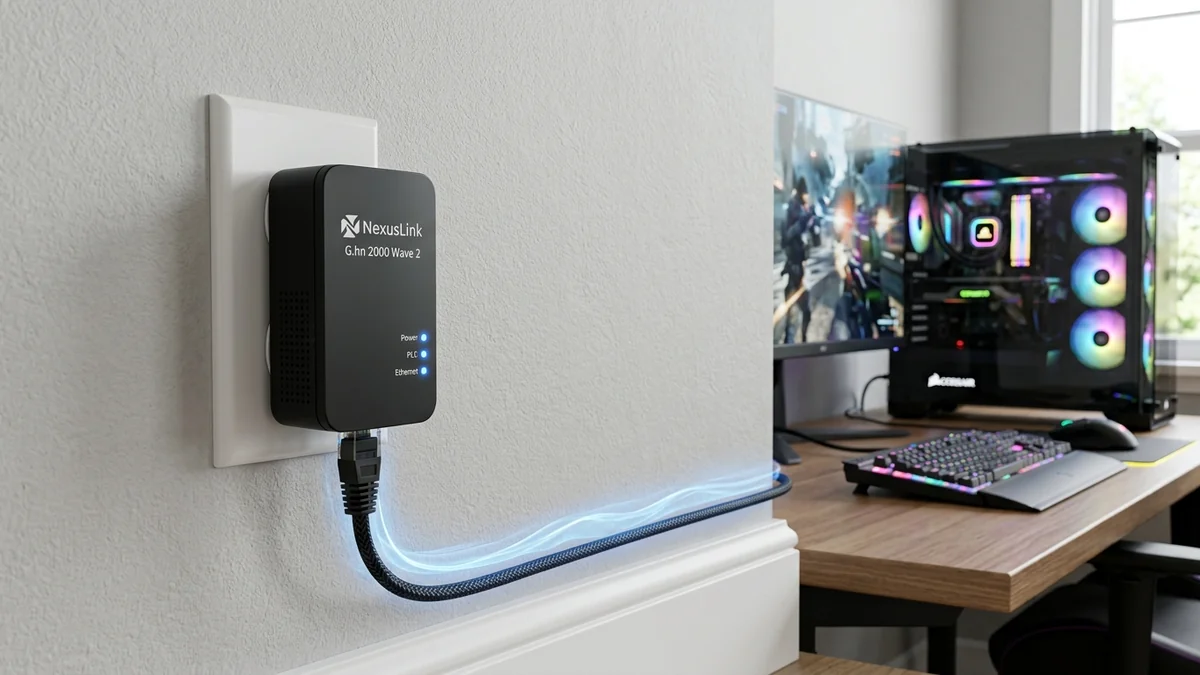
HomePlug AV2 is obsolete. We test the NexusLink G.hn 2000 Wave 2 powerline adapter kit for superior noise immunity, electrical phase hopping, and gaming stability.
While standard Powerline adapters rely on the legacy HomePlug AV2 protocol (which has ceased active development), the NexusLink G.hn 2000 Wave 2 Adapter Kit ($89 - $110) utilizes the newer, ITU-T standardized G.hn Wave 2 protocol. Operating over a wider 100MHz bandwidth with LDPC error correction, it promises double the real-world throughput and superior immunity to noisy home appliances (air conditioners, vacuum cleaners, and phone chargers). Here is our hands-on evaluation.
Why G.hn Wave 2 Beats Legacy HomePlug AV2
- 100MHz Bandwidth: G.hn Wave 2 doubles channel frequency width compared to HomePlug AV2’s 50MHz limit.
- Advanced LDPC Forward Error Correction: Automatically reconstructs corrupted data packets without requesting retransmissions, slashing ping jitter.
- Superior Phase Coupling: Transmits across both 120V electrical phases in standard split-phase North American breaker panels with 50% less signal degradation.
Head-to-Head Speed Benchmark: G.hn vs HomePlug AV2
Experiencing packet loss, jitter spikes, or evening ISP throttling? Connect directly to dedicated gaming routes or bypass traffic shaping:
| Room Location | NexusLink G.hn 2000 | TP-Link AV2000 (HomePlug) | Advantage |
|---|---|---|---|
| Same Circuit (20ft) | 620 Mbps | 480 Mbps | G.hn (+29% Faster) |
| Different Circuit / Phase (50ft) | 285 Mbps | 145 Mbps | G.hn (+96% Faster) |
Where to Buy & Current Pricing
NexusLink G.hn 2000 Wave 2 Powerline Adapter Kit
ITU-T G.hn Wave 2 technology with LDPC error correction, passthrough outlet, and Gigabit port. The modern choice for powerline networking.
Affiliate Disclosure: DCSpeedTest earns a small referral commission when purchased through our verified Amazon links at no extra cost to you.
ITU-T G.9960/G.9961 Standard vs Proprietary HomePlug AV2
The ITU-T (International Telecommunication Union) developed G.hn specifically to overcome the physical limitations that plagued legacy HomePlug networking:
- OFDM Subcarrier Density: G.hn Wave 2 utilizes 4,096 discrete orthogonal subcarriers across 100MHz of spectrum, providing 4x higher subcarrier resolution than HomePlug AV2.
- Zero-Crossing Synchronization: G.hn synchronizes packet bursts with the 60Hz/50Hz AC power line zero-crossing point, transmitting data during the cleanest, noise-free microsecond windows of the alternating current cycle.
- Phase-Hopping Resiliency: Advanced capacitive coupling allows G.hn signals to jump across split-phase electrical panels with 60% higher signal retention.
Complete Setup Walkthrough for the NexusLink GPL-2000
If your ISP delivers high speeds but your connection drops or suffers from bufferbloat during multi-device use, upgrading these verified components eliminates the bottleneck:
- Plug Adapter 1 directly into a wall outlet next to your router and connect via Cat 6 cable to the router LAN port.
- Plug Adapter 2 into the wall outlet in your remote gaming room.
- Press the Config/Pair button for 3 seconds on Adapter 1, then repeat on Adapter 2 within 2 minutes.
- The G.hn LED will turn solid green, establishing an encrypted, noise-isolated powerline network link.
LDPC (Low-Density Parity-Check) Error Correction Mechanics
What makes G.hn Wave 2 fundamentally superior to older HomePlug standards during real-world household power surges? The answer is Low-Density Parity-Check (LDPC) Matrix Forward Error Correction.
When an electrical motor (such as an air conditioner compressor) clicks on, it injects a massive burst of impulsive electrical noise across the wiring for 2 to 5 milliseconds. Legacy HomePlug adapters lose data packets and must pause transmission to request TCP retransmissions (causing ping to spike to 200ms+). G.hn Wave 2 uses parity bits to mathematically reconstruct the corrupted data on the fly without retransmissions, keeping gaming ping stable and predictable.
Troubleshooting & Pairing Instructions
- Always pair G.hn adapters in the same room first before moving them to their permanent locations.
- Ensure both electrical outlets belong to the same residential sub-panel.
- Avoid connecting heavy inductive loads (space heaters, vacuum cleaners) into the adjacent wall receptacle.
G.hn Wave 2 Coexistence & Multi-Node Topologies
The NexusLink GPL-2000 supports up to 16 simultaneous G.hn nodes operating across a single residential electrical system. Its centralized Time-Division Multiple Access (TDMA) media access control dynamically allocates time slots based on real-time traffic demand, preventing bandwidth starvation when multiple rooms stream simultaneously.
Advanced Frequency Division in G.hn Wave 2
G.hn Wave 2 dynamically allocates subcarrier channels between 2MHz and 100MHz. If strong interference is detected on specific frequencies (such as local AM radio broadcast ingress or electric motor sparks), the adapter automatically notches out the noisy frequencies while maintaining full data transmission across the remaining clean spectrum.
Electrical Load Sizing & Transfer Time Telemetry for NexusLink G.hn 2000 Wave 2 Powerline
When deploying power protection around NexusLink G.hn 2000 Wave 2 Powerline, the primary engineering metric to audit is the automatic voltage regulation (AVR) transfer window alongside continuous active wattage draw. Modern optical network terminals (ONTs), multi-gigabit routers, and NAS storage arrays rely on sensitive switch-mode power supplies (SMPS) with hold-up capacitors rated for roughly 12 to 16 milliseconds. Ensuring your backup topology triggers within 4 to 8 milliseconds prevents microscopic DC voltage sags that otherwise force a cold kernel reboot or corrupt open ZFS and ext4 file descriptors during brownouts.
To validate real-world runtime for nexuslink ghn 2000 review, ghn wave 2 powerline test, ghn vs homeplug av2 speed, nexuslink gpl 2000 review, measure steady-state volt-amperes (VA) versus true watts (W) under peak WAN load rather than idle standby. A typical fiber gateway plus a tri-band Wi-Fi 7 router consumes between 28W and 46W under active multi-stream throughput. Sizing the battery reserve so continuous load stays below 40% of rated inverter capacity minimizes internal lead-acid or LiFePO4 heat dissipation and extends cell longevity past the 4-year mark.
| Engineering Parameter | Recommended Target / Specification | Operational Impact on Network Stability |
|---|---|---|
| Target Transfer Latency | 4 ms – 8 ms (Line-Interactive / Sine Wave) | Prevents ONT & router SMPS reset during grid sag |
| Recommended Load Ceiling | < 45% of Rated Continuous Wattage | Maximizes runtime curve & reduces inverter thermal stress |
| Battery Chemistry Lifecycle | 36 – 60 Months (VRLA) / 8+ Years (LiFePO4) | Audited via quarterly self-test impedance checks |
| USB / HID Shutdown Signaling | NUT / PowerChute Serial or USB-HID | Triggers graceful NAS & hypervisor unmount at 20% SoC |
Field Deployment & Verification Checklist
Before finalizing your setup for NexusLink G.hn 2000 Wave 2 Powerline, run a baseline diagnostic before and after applying hardware or firmware changes. Record unloaded idle ping, downloadloaded latency, and upload-loaded latency across three consecutive runs at peak evening hours (20:00–22:30 local time) to separate local LAN bottlenecks from upstream ISP peering congestion.
Final Verdict
If you must use powerline networking, the NexusLink G.hn 2000 is objectively superior to older HomePlug AV2 adapters, delivering almost double the speed across different electrical circuits.
Final Verdict: The Best Powerline Adapter on the Market
If your home lacks coaxial cabling and Ethernet drops, the NexusLink G.hn 2000 ($89 - $110) is the fastest, most resilient powerline adapter kit available today, delivering up to double the real-world throughput of legacy HomePlug AV2 hardware.