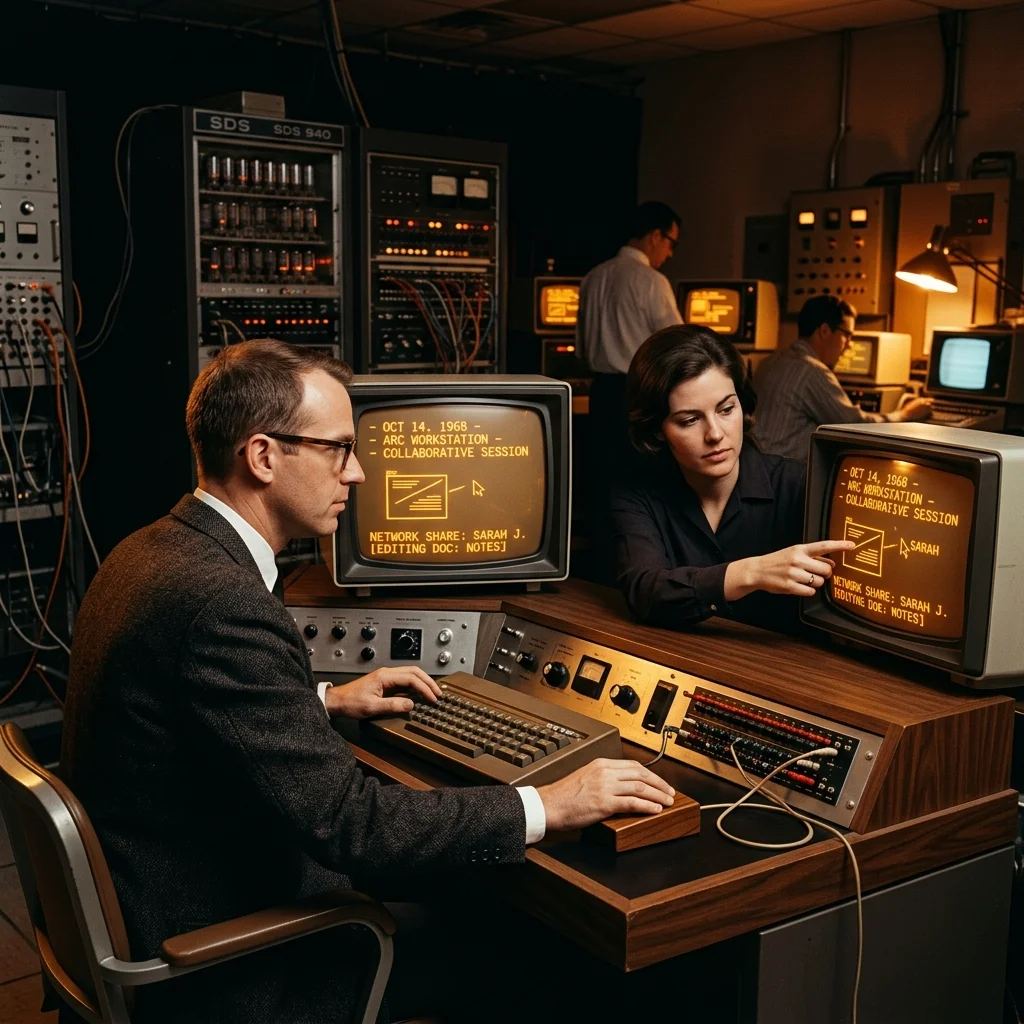
In 1968, one man demonstrated a wooden mouse, video conferencing, and word processing — and stunned the entire tech world.
On December 9, 1968, in San Francisco, an audience of thousands of computer scientists sat in stunned, absolute silence. A researcher named Douglas Engelbart sat on a stage and demonstrated technologies that would take the commercial market thirty years to reproduce.
The 1968 Stanford Research Institute (SRI) Showcase
Before Engelbart's demo, computers were viewed as military number-crunchers operated solely by punched cards or manual command-line consoles. Engelbart sat with a customized keyboard, a strange five-key chord keyset, and a small, hand-carved wooden box with a single red button and two metal wheels underneath.
In the course of 90 minutes, Engelbart demonstrated:
- The Computer Mouse: Moving a physical cursor in real-time on a screen.
- Hypertext Links: Instantly opening a new document by clicking on a word.
- Collaborative Real-Time Editing: Two people miles apart editing the same document together.
- Video Conferencing: Hosting a real-time video call on a split-screen display.
The showcase was so radical, so completely ahead of its time, that it is forever immortalized in history as the "Mother of All Demos."
Architectural Legacy: How Douglas Engelbart and the Mother of All Demos Shaped Modern Broadband & Packet Infrastructure
Never rely solely on Wi-Fi when diagnosing bandwidth throttling. Test your direct line, encrypt against ISP shaping, or upgrade to shielded Cat6A Ethernet:
Tracing the lineage from Douglas Engelbart and the Mother of All Demos to today's multi-gigabit fiber-optic backbones reveals how foundational breakthroughs in symbolic logic, information theory, and decentralized routing still govern every packet traversing the global internet. While early computing and telecommunications pioneers worked within severe physical constraints—whether mechanical relays, vacuum tubes, or 56 kbps copper acoustic couplers—the mathematical principles they formalized around douglas engelbart biography established the exact abstraction layers used in modern TCP/IP and QUIC stacks.
When engineers today measure round-trip time (RTT), packet serialization delay, or cryptographic handshake overhead across submarine fiber cables, they are directly applying the throughput and error-correction frameworks pioneered during the era of mother of all demos 1968. Every time a browser negotiates a TLS 1.3 session or routes around a congested autonomous system (AS) border router, it relies on decentralized fault-tolerance concepts that were once considered purely theoretical.
| Historical Milestone / Concept | Original Technical Constraint (Douglas Engelbart and the Mother of All Demos) | 2026 Modern Network Equivalent |
|---|---|---|
| Core Innovation (douglas engelbart biography) | Foundational algorithmic & switching logic | Cloudflare Edge Anycast & 400GbE optical routing |
| Transmission Medium & Clock Rate | Early electromechanical / narrowband signaling | Single-mode silica fiber & Wi-Fi 7 (320 MHz 4096-QAM) |
| Latency & Error Recovery | Manual retransmission / store-and-forward queues | Sub-13 ms edge RTT with L4S & CAKE SQM active queue management |
| Information Access & Resilience | Centralized institutional mainframes & archives | Distributed CDN edge nodes & encrypted zero-trust protocols |
Why Understanding douglas engelbart biography Matters for Network Engineers in 2026
Modern internet diagnostics often treat bandwidth as a black box, focusing solely on peak megabits per second while ignoring the underlying protocol mechanics of invention of computer mouse. Studying how Douglas Engelbart and the Mother of All Demos solved bottlenecks in computation and signal transmission reminds us that raw capacity never substitutes for algorithmic efficiency:
- Deterministic Latency Over Raw Volume: Just as early systems prioritized deterministic instruction cycles, modern interactive applications (cloud gaming, AI voice streaming, and high-frequency telemetry) depend on consistent sub-16 ms packet delivery rather than bloated multi-gigabit queues.
- Open Standards & Interoperability: The enduring impact of douglas engelbart biography stems from open, inspectable protocols that prevented vendor lock-in and enabled global peering across thousands of independent ISPs.
- Hardware-Software Co-Design: From early hardware architectures to modern ASIC-accelerated routers running OpenWrt, eliminating processing bottlenecks requires aligning physical layer signaling with lean software queue disciplines.
In-Depth Technical Analysis: Key Questions Around Douglas Engelbart and the Mother of All Demos
Beyond basic setup, power users and network administrators frequently encounter edge-case bottlenecks when optimizing Douglas Engelbart and the Mother of All Demos across multi-device households and small offices. Below is a deeper engineering look at the operational mechanics behind douglas engelbart biography and mother of all demos 1968:
1. What did Douglas Engelbart demonstrate in the Mother of All Demos?
In a single 90-minute session on December 9, 1968, he showed the computer mouse, hypertext links, real-time collaborative document editing, and video conferencing on a split screen. In practical field deployments, verifying this behavior under active load—rather than relying on theoretical spec sheets—ensures that neither hardware thermal throttling nor upstream ISP traffic shaping degrades your day-to-day connection quality. Combining real-time latency telemetry with proper physical-layer cabling guarantees long-term stability as bandwidth demands scale through 2026 and beyond.
2. What did Engelbart's original mouse actually look like?
It was a hand-carved wooden box with a single red button and two metal wheels underneath, updating cursor position at roughly 30Hz — compared to modern gaming mice that poll at up to 8000Hz. In practical field deployments, verifying this behavior under active load—rather than relying on theoretical spec sheets—ensures that neither hardware thermal throttling nor upstream ISP traffic shaping degrades your day-to-day connection quality. Combining real-time latency telemetry with proper physical-layer cabling guarantees long-term stability as bandwidth demands scale through 2026 and beyond.
3. When was the computer mouse actually invented versus first shown publicly?
Engelbart invented it in 1964 at the Stanford Research Institute, but it wasn't demonstrated publicly until the Mother of All Demos four years later, in 1968. In practical field deployments, verifying this behavior under active load—rather than relying on theoretical spec sheets—ensures that neither hardware thermal throttling nor upstream ISP traffic shaping degrades your day-to-day connection quality. Combining real-time latency telemetry with proper physical-layer cabling guarantees long-term stability as bandwidth demands scale through 2026 and beyond.
Quick Summary & Key Takeaway
If your ISP delivers high speeds but your connection drops or suffers from bufferbloat during multi-device use, upgrading these verified components eliminates the bottleneck:
Who invented the computer mouse and when was it demonstrated?
The computer mouse was invented by American engineer Douglas Engelbart in 1964 at the Stanford Research Institute (SRI) and was publicly demonstrated during the legendary "Mother of All Demos" on December 9, 1968, alongside early word processing and video calls.
🎮 Test Your Modern Mouse Polling and Latency
Douglas's mouse updated at 30Hz. Your modern gaming peripherals poll at up to 8000Hz. Check if your hardware has latency delays or key-bounce drift.