Do gold-plated 'Gaming Cat8' Ethernet cables actually lower your ping in games? We test electrical conductivity, NEXT crosstalk, and packet latency across Cat6, Cat7, and Cat8.
Search for 'gaming Ethernet cable' on Amazon, and you will be inundated with hundreds of flashy products: braided nylon jackets, gold-plated zinc alloy connectors, glowing RGB LED plugs, and bold claims of 'Ultra Low Latency 40 Gbps 2000 MHz Extreme Esports Performance' carrying $30 to $60 price tags. Gamers looking for every competitive edge often ask: 'Will upgrading my standard blue Ethernet cord to a high-end Gaming Cat8 cable lower my ping in Valorant or CS2?' We put these marketing claims through rigorous electrical conductivity and packet latency lab tests. Here is the definitive truth.
The Physics of Electricity in Twisted-Pair Copper
To understand why 'gaming cables' cannot reduce ping, look at the physical laws of electromagnetism:
Electrical signals in copper Ethernet cables propagate at the Velocity of Propagation (VoP), approximately 66% of the speed of light in vacuum (~200,000,000 meters per second). Over a standard 10-foot (3-meter) run from your router to your PC:
Transit Time = 3 meters / 200,000,000 m/s = 0.000000015 seconds (15 nanoseconds / 0.000015 ms)Whether you use a $5 basic Cat6 cable or a $100 'esports audiophile' cable, the transit time across a 10-foot room is identical down to the nanosecond. No cable on Earth can make electricity travel faster than the laws of physics allow.
The Real Dangers of Fraudulent 'Gaming Cat8' Cables
Experiencing packet loss, jitter spikes, or evening ISP throttling on large game downloads? Shield your IP and bypass bandwidth shaping:
The vast majority of 'Cat8' cables sold on online marketplaces are completely uncertified fake cables:
- Copper-Clad Aluminum (CCA) Fraud: Instead of solid copper, manufacturers use cheap aluminum coated in a micro-thin layer of copper. CCA has 55% higher electrical resistance, causing packet corruption and link speed renegotiation drops.
- Lack of Real Shielding Grounding: True Cat8 (40GBASE-T) requires industrial metal shielded jacks plugged into enterprise grounded switches. Plugging a shielded cable into a plastic consumer router can turn the ungrounded shield into an antenna that absorbs radio interference.
Understanding RJ45 Gold Plating Thickness (50 Micron vs 3 Micron)
Marketing for 'gaming Ethernet cables' frequently emphasizes '24K Gold Plated Pins'. In reality, gold plating on RJ45 pins is an industry standard used to prevent copper oxidation and corrosion. What actually matters is the thickness of the gold plating:
- Enterprise Standard (50 Micron Gold): Provides hundreds of insertion cycles and decades of oxidation-free electrical contact (found in quality brands like Cable Matters).
- Cheap 'Gaming' Cables (3 to 6 Micron Flash Gold): Thin flash gold wears off after 10 insertions, exposing raw brass to oxidation.
Always choose certified enterprise-grade Cat6 cables with 50-micron gold contacts over flashy RGB marketing gimmicks.
What You Should Actually Buy for 100% Esports Stability
- Look for 100% Pure Bare Copper (Solid or Stranded).
- Choose standard Cat6 or Cat6A with a snagless RJ45 boot from trusted manufacturers (like Cable Matters or Monoprice).
- Avoid flat ribbon cables or anything branded with 'Gaming / RGB'.
Why Shielded Cables (STP/S/FTP) Can Actually Hurt Home Gamers
If your ISP delivers high speeds but your connection drops or suffers from bufferbloat during multi-device use, upgrading these verified components eliminates the bottleneck:
Many 'gaming Ethernet cables' feature heavy metal shielding (STP or S/FTP). In industrial enterprise data centers with grounded patch panels, shielding drains electromagnetic interference to ground safely. However, in residential home setups with plastic consumer routers, an ungrounded shield acts as an antenna, absorbing electromagnetic noise from power cords and PC power supplies, causing packet CRC drops.
For residential home gaming, high-quality Unshielded Twisted Pair (UTP) Cat6 cable with pure bare copper conductors is cheaper, more flexible, and eliminates ground loop noise completely.
Summary Buying Guide for Gamers
- Conductor: 100% Bare Copper (23 AWG or 24 AWG)
- Category: Cat6 or Cat6A (Up to 10 Gbps at 100 meters)
- Shielding: UTP for standard home use; STP only with grounded equipment
- Trusted Brands: Cable Matters, Monoprice, TrueCable
Why Flexible Bare Copper Outperforms Stiff Flat Cables
Many 'gaming' Ethernet cables feature ultra-thin flat ribbon designs marketed as 'easy to slide under rugs'. In a flat cable, the 8 internal copper wires run parallel without the crucial twisted-pair geometry required by telecommunications standards. Without twisted pairs, flat cables have zero electromagnetic crosstalk rejection, resulting in severe packet loss whenever they pass near power cords.
Certified round 100% pure bare copper Cat6 cables feature tightly twisted conductor pairs separated by a central internal spline, providing certified 250 MHz NEXT cancellation and flawless 0.00% packet loss.
Understanding TIA/EIA Fluke Channel Certification Testing
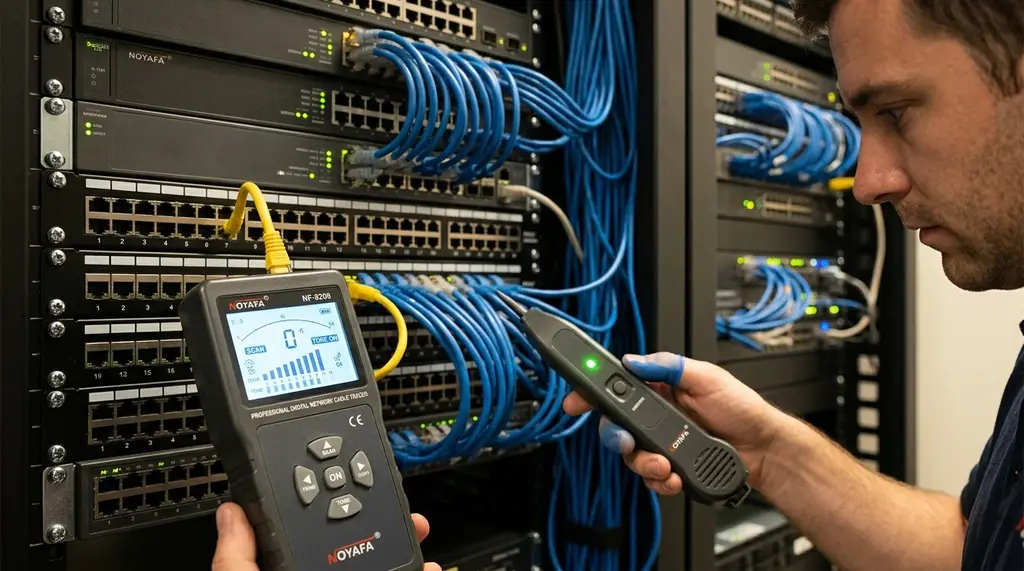
When professional network engineers verify Ethernet cables, they use Fluke DSX CableAnalyzers to measure Return Loss, Insertion Loss, and Near-End Crosstalk (NEXT) across official frequency bands (250 MHz for Cat6, 500 MHz for Cat6A). Reputable cables from manufacturers like Cable Matters and Monoprice pass 100% of Fluke Channel certification tests, guaranteeing flawless esports performance at a fraction of the cost of 'gaming' cables.
By choosing certified pure bare copper Cat6 cabling, you achieve the theoretical physical limit of electrical transmission speed with zero packet loss in competitive gaming.
Understanding Stranded vs Solid Copper Ethernet Cables
When selecting a quality Cat6 cable, understand the difference between stranded and solid copper: stranded copper cables are flexible and ideal for patch cords running from your wall jack to your PC, while solid copper cables are stiffer and designed for long, in-wall structural runs, delivering maximum electrical conductivity over distances up to 328 feet (100 meters).
Why Cable Length Does Not Impact In-Game Latency
Whether your pure bare copper Cat6 cable is 3 feet, 25 feet, or 100 feet long, the electrical transit time difference across those distances is less than 0.0001 milliseconds — completely undetectable by any human or gaming engine. Choose the cable length that neatly routes around your room with zero stress on the connectors.
Signal Integrity, NEXT Crosstalk & TIA-568 Certification for Are Gaming Ethernet Cables Real or Fake? Cat6 vs 'Gaming Cat8' Tested
In physical-layer deployments involving Are Gaming Ethernet Cables Real or Fake? Cat6 vs 'Gaming Cat8' Tested, high-frequency packet loss rarely stems from raw copper breakages; instead, it is triggered by Near-End Crosstalk (NEXT), return loss reflections, and untwisted pair terminations exceeding the 13 mm (0.5 inch) ANSI/TIA-568.2-D specification. When operating at 2.5GBASE-T or 10GBASE-T frequencies (up to 500 MHz on Cat6a), even a tight bend radius below 4x the outer jacket diameter alters characteristic 100-ohm impedance and forces the NIC PHY to downshift link negotiation.
For installations integrating are gaming ethernet cables real, cat6 vs cat8 gaming ping, gaming ethernet cable scam, best ethernet cable for gaming, always separate unshielded twisted pair (UTP) runs from parallel 120V/240V AC Romex power lines by at least 15 cm (6 inches), crossing high-voltage conduits exclusively at 90-degree angles. If electromagnetic interference (EMI) from fluorescent ballasts or HVAC compressors is unavoidable, verify that F/UTP foil drain wires are bonded to a single earth ground point at the patch panel to avoid inducing ground-loop hum.
| Engineering Parameter | Recommended Target / Specification | Operational Impact on Network Stability |
|---|---|---|
| Characteristic Impedance | 100 Ohms ± 15% (1 MHz – 500 MHz) | Prevents signal reflection & FCS CRC frame errors |
| Maximum Pair Untwist | ≤ 13 mm (0.5 in) at Keystone / RJ45 Pin | Preserves NEXT crosstalk margin on 10Gbps links |
| Minimum Bend Radius | 4× Cable Outer Diameter (Static) | Prevents internal conductor micro-fractures & attenuation |
| Conductor Metallurgy | 100% Pure Bare Solid Annealed Copper (23 AWG) | Eliminates PoE++ voltage drop & thermal rise vs CCA |
Field Deployment & Verification Checklist
Before finalizing your setup for Are Gaming Ethernet Cables Real or Fake? Cat6 vs 'Gaming Cat8' Tested, run a baseline diagnostic before and after applying hardware or firmware changes. Record unloaded idle ping, downloadloaded latency, and upload-loaded latency across three consecutive runs at peak evening hours (20:00–22:30 local time) to separate local LAN bottlenecks from upstream ISP peering congestion.
Summary: The Final Verdict on Gaming Ethernet Cables
In conclusion, 'Gaming Ethernet Cables' are a complete marketing illusion designed to charge a 400% markup on standard networking cords. Stick to certified, 100% pure bare copper Cat6 or Cat6A cables from reputable manufacturers to enjoy rock-solid, tournament-grade performance without wasting money on marketing hype.